The 30-Year Stress Test: Surviving a "Lost Decade"
Introduction
We’ve previously explored Understanding Guardrails: A Strategy for Retirement Longevity. The idea was straightforward: construct a diversified mix of Australian shares, international shares, and bond ETFs with the aim of improving resilience across different market conditions.
- A quick note on geography: While this model has an Australian focus, the broader concepts may be relevant in other markets. Adjustments — particularly to domestic allocations — would be required depending on your local context.
However, describing a portfolio as "weatherproof" is conceptual rather than literal. The real question is how such an approach might behave during prolonged periods of economic stress.
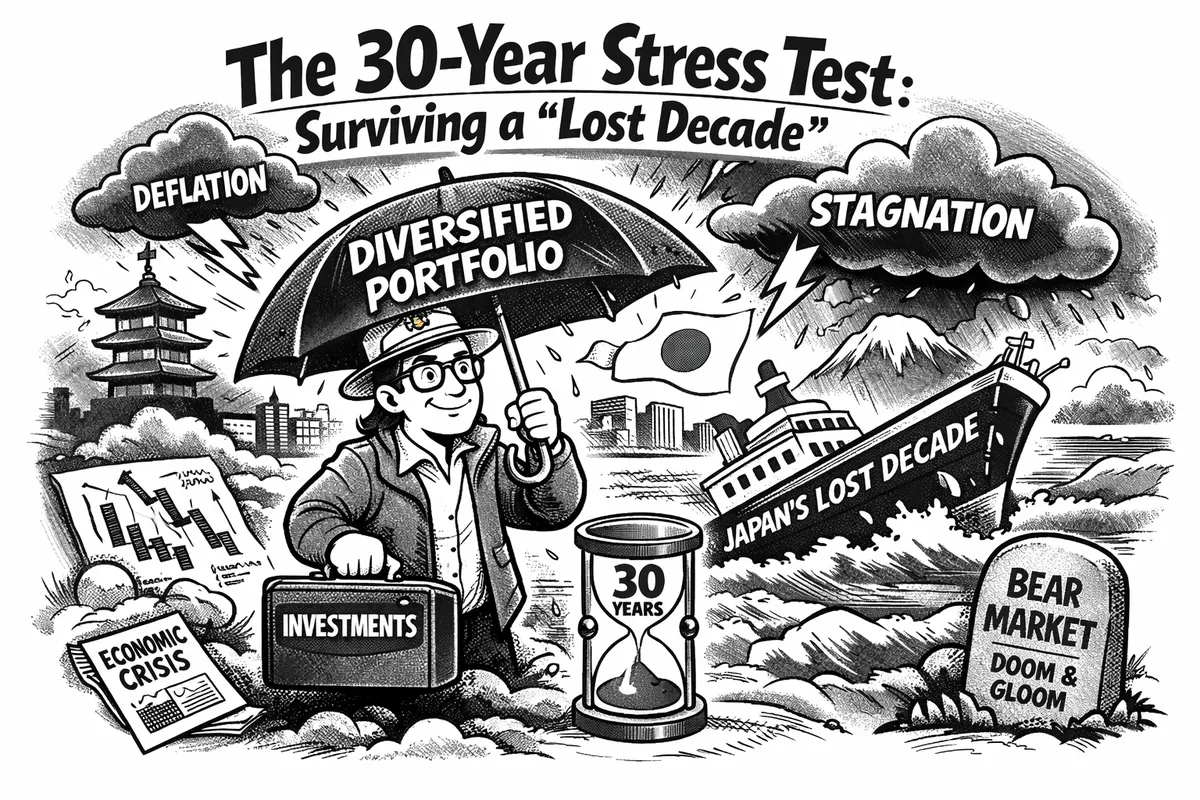
To explore this, we can look at Japan’s "Lost Decades", often cited as an example of extended market stagnation.
The Ultimate Financial Fog
Between 1990 and the early 2000s, Japan experienced a long period of economic slowdown following the burst of asset price bubbles. Deflationary pressures, subdued growth, and cautious consumer behaviour shaped the environment.
Central bank policies evolved over time, but recovery was gradual and uneven. For investors, this period is often used as a case study in what extended low-return conditions might look like.
The Simulation Approach
To better understand how a diversified portfolio might behave in such an environment, I ran a Japan "Lost Decades" stress test simulation extending roughly 30 years.
Because ETFs were not widely available at the start of this period, the analysis relies on historical proxies (for example, Japanese Government Bonds instead of modern bond ETFs). These substitutions introduce limitations and should be interpreted with caution.
It’s important to emphasise that this is a simplified model. It does not account for all real-world factors such as taxes, fees, behavioural decisions, or changing economic conditions.
What the Data Suggests
In this specific historical scenario, the diversified portfolio showed a degree of stability relative to holding a single asset class. The inclusion of both international equities and bonds appeared to reduce overall volatility compared to more concentrated approaches.
That said, outcomes varied across time periods, and there were extended stretches of low or negative returns. This reinforces an important point: diversification may help manage risk, but it does not eliminate the possibility of loss or guarantee returns.
A useful way to think about this is that diversification is designed to manage uncertainty — not remove it.
The Bottom Line
Japan’s “Lost Decades” remains a widely discussed example of prolonged economic difficulty. Analysing such periods can provide perspective on how different asset allocations might respond under stress.
However, historical analysis has limitations. Past performance is not a reliable indicator of future results, and no portfolio structure can be considered universally "safe" or "weatherproof."
A diversified approach may help investors navigate uncertainty, but individual outcomes will always depend on personal circumstances, time horizon, and risk tolerance.
Important Information:
This content is provided for general informational and educational purposes only and does not constitute financial, investment, or tax advice. It does not take into account your personal objectives, financial situation, or needs. Any examples or simulations are illustrative only and are based on assumptions that may not reflect real-world outcomes. Before making any financial decisions, you should consider seeking advice from a licensed financial professional.