Expectations vs Expectancy: Why Long-Term Success Is a Math Problem
Introduction
We are hardwired to crave immediate feedback. When we exert effort, we instinctively want an equal and opposite reward, preferably delivered by the end of the business day. This cause-and-effect relationship works fine for domestic chores or physical labour, but in the world of investing and long-term planning, it is a mental trap.
To navigate the complexities of wealth and well-being, we have to bridge the gap between two concepts that sound similar but operate in entirely different worlds: expectations and expectancy.
The Mechanics of Expectancy
In any financial cycle - whether you are trading, managing a retirement portfolio, or building a business - success relies on a system with positive expectancy. Simply put, the "math" must be in your favour over a long enough timeline.
This isn't guesswork; it is a cold, hard formula that professional risk-takers live by:
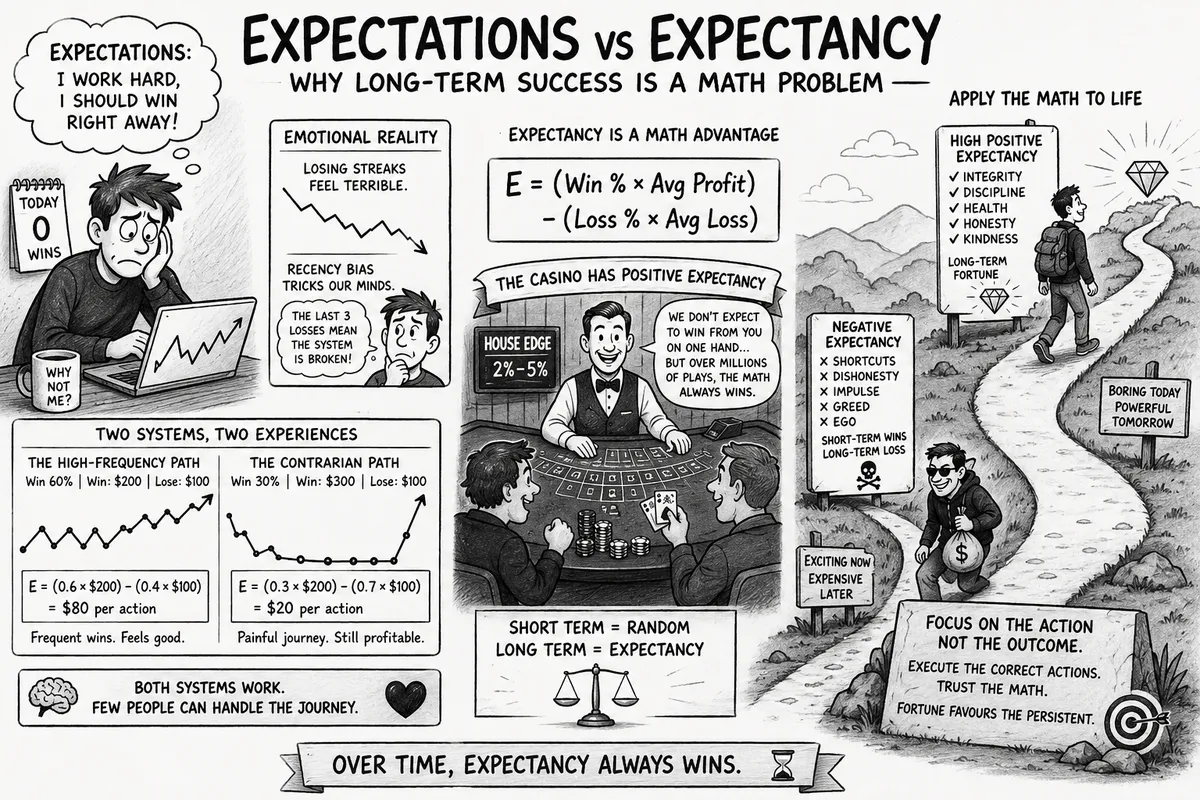
E = (Win Percentage × Average Profit) - (Loss Percentage × Average Loss)
Let’s look at how this plays out in practice with two different strategies:
The High-Frequency Path
Imagine a system where you win 60% of the time. When you win, you make $200. When you lose, you lose $100 (your unit of risk, or "R").
Your expectancy is: (0.6 × $200) - (0.4 × $100) = $80.
On average, you earn $80 every time you act. This feels comfortable because the "wins" happen frequently, providing the ego with regular hits of dopamine.
The Contrarian Path
Now, consider a system with only a 30% win rate. You lose seven times out of ten. However, when you do win, you make $300 for every $100 risked.
Your expectancy is: (0.3 × $300) - (0.7 × $100) = $20.
You are still making money - $20 per action - but the experience is bruising. You will endure long, demoralising losing streaks before a big win arrives to carry you forward.
Both systems are mathematically sound. But while the math is robust, the human element is fragile. The second system, despite being profitable, is where most people fail because they cannot handle the psychological "drawdown" of repeated losses.
The Friction of Expectations
This is where the wheels usually fall off. Expectations are the emotional demands we place on the universe. We expect that if we’ve done the research and followed the rules, the next trade should be a winner.
In reality, the most common error in investing is failing to remain consistent when the results don't match our immediate desires. We start with good intentions, but as soon as we hit a losing streak, we panic. We begin to question our logic, "tweak" the strategy, or abandon the plan entirely before the law of averages has had a chance to prove itself.
We are often victims of recency bias - the tendency to believe that the last three data points represent the entire future. If our last three investments flopped, we assume the system is broken.
Markets are random in the short term, but they reflect expectancy in the long term. Think of a casino. The "house" has a tiny edge - usually between 2% and 5%. That is their positive expectancy. They have no expectation of making money from you personally on a single hand of blackjack. They might lose to you all night. But they are perfectly confident that over thousands of players and millions of spins, they will make a fortune. They don’t change the rules just because one person gets lucky.
Taking the Logic Beyond the Ledger
This principle is a master key for life outside of finance. We often feel a sense of injustice when we see people "getting ahead" by cutting corners, being dishonest, or bypassing the rules. We see their short-term success and feel like we are the ones losing out.
But if you look at their lives through the lens of expectancy, the perspective shifts. Someone who regularly does the wrong thing is playing a game with negative expectancy. They might find a short-term win, but they are essentially gambling with their future. Over a long enough timeline, the math catches up. They eventually lose their reputation, their health, their capital, or their most important connections.
True success is found by shifting your focus from the outcome to the action.
Doing the right thing - being fair, staying disciplined with your health, and maintaining honesty - is a system with high positive expectancy. You cannot control the "short-term noise" of life. You can’t control how someone reacts to your kindness today, or if your hard work is immediately recognised by your peers.
Your definition of success should be the execution of the "correct action" - something entirely within your control.
If you commit to a system of integrity, you may feel like you’re falling behind in the short term. However, if you trust the math of your character, fortune eventually favours the persistent. In the end, prosperity, health, and deep relationships won't be a matter of luck - they will be the inevitable result of your expectancy.