Beyond the Ticker: Why a "Buy" Rating is Not a Plan
We’ve all seen them. The bold-faced headers on financial news sites or the crisp PDFs from brokerage firms: BUY, HOLD, or SELL.
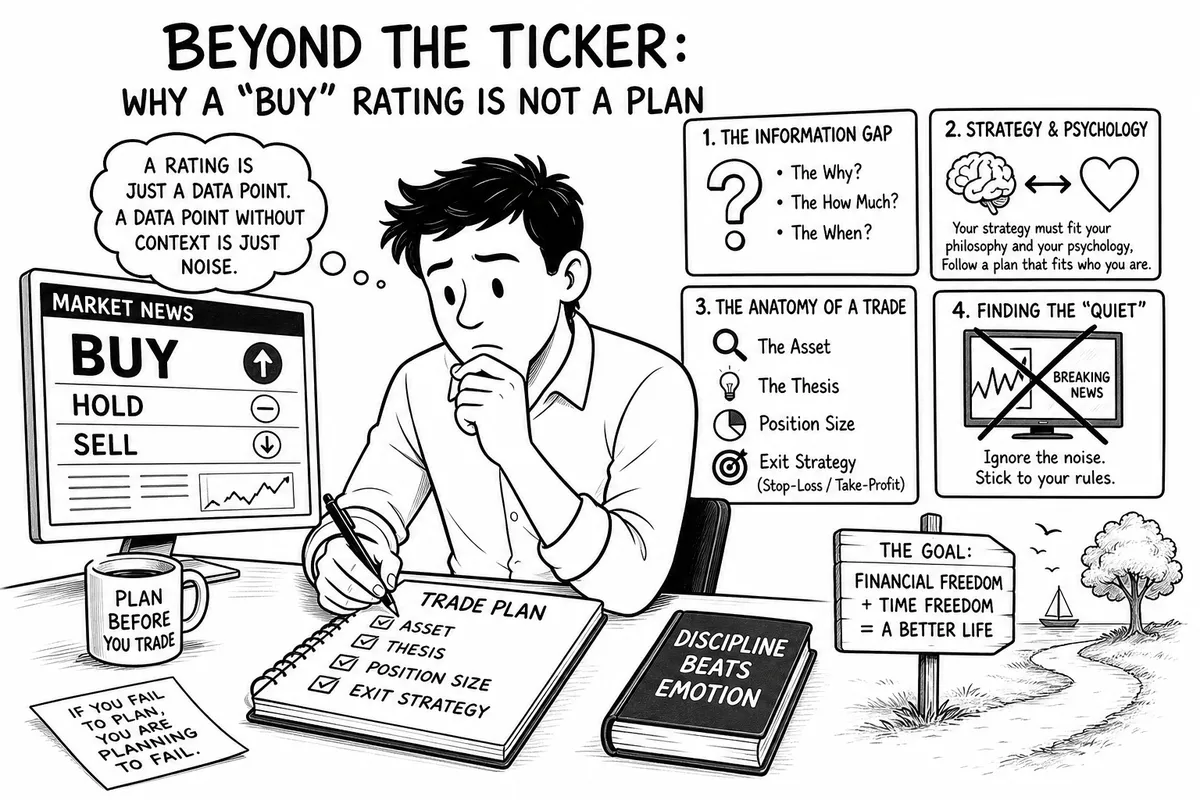
For many investors, these three words are treated like gospel. They are the green, amber, and red lights of the financial world. But here is the problem: a rating is just a data point, and a data point without context is just noise.
If you’re buying a stock simply because an analyst gave it a "Buy" rating, you’re essentially flying a plane without a flight plan. You might be in the air, but you have no idea where you’re landing - or what to do if you hit turbulence.
The Information Gap
A "Buy" rating on its own doesn't tell you the "why," the "how much," or the "when."
Before you click that trade button, you need to ask:
- What was the decision based on? Is it a short-term technical play or a long-term value play?
- Does it fit your philosophy? If you are a conservative income investor, a "Buy" rating on a volatile, non-dividend-paying tech startup is irrelevant to you.
- Where is the exit? At what price do you take a profit? More importantly, at what point do you admit the thesis was wrong and cut your losses?
As the old saying goes: If you fail to plan, you are planning to fail.
The Intersection of Strategy and Psychology
Successful investing isn't just about maths; it’s about temperament. Your strategy must be built on a philosophy that aligns with your personal risk profile and your psychology.
Why? Because if your plan doesn't "fit" who you are, you won't follow it. When the market dips — and it always does — you will start to second-guess. You’ll hesitate when you should act, and you’ll panic when you should stay still.
Investment success is less about "beating the market" and more about perfect execution. This means minimising "unforced errors" — the mistakes we make when we deviate from our own rules.
The Anatomy of a Trade
When you enter a position — whether you’re going "long" (buying) or "short" (betting it will fall) — the rules should already be written down on paper. You should know:
- The Asset: Exactly what are you holding?
- The Thesis: Why are you holding it?
- The Position Size: How much are you risking? (A topic for another blog?).
- The Exit Strategy: Your "stop-loss" and your "take-profit" levels.
By laying these rules out in advance, you remove the burden of decision-making during market hours. You aren't "trading"; you are simply executing a pre-arranged plan. If you need to tweak your strategy, you do so when you are calm and collected — not in the heat of the moment.
Finding the "Quiet" in the Noise
If you find yourself glued to the screen, watching financial news with your heart rate climbing, something is wrong.
A well-constructed system should be simple. It shouldn’t require you to be a slave to the "breaking news" ticker. In fact, most of the noise you hear on financial television is designed to trigger your emotions - pulling you left, right, and centre.
When your rules are set, you can keep the noise to a minimum. You aren't disadvantaged by ignoring the chatter; in fact, you're likely better off for it.
The ultimate goal of this disciplined approach isn't just to make money — it's to buy back your time. It leaves you free to pursue your other interests, whether that's socialising or diving into your hobbies. It reduces the stress of market anxiety and lets you live your life.
Investing should support your life, not consume it. Stop living in the waiting room of "what if" and start trading with a map.
Important Information:
This content is provided for general informational and educational purposes only and does not constitute financial, investment, or tax advice. It does not take into account your personal objectives, financial situation, or needs. Before making any financial decisions, you should consider seeking advice from a licensed financial professional.